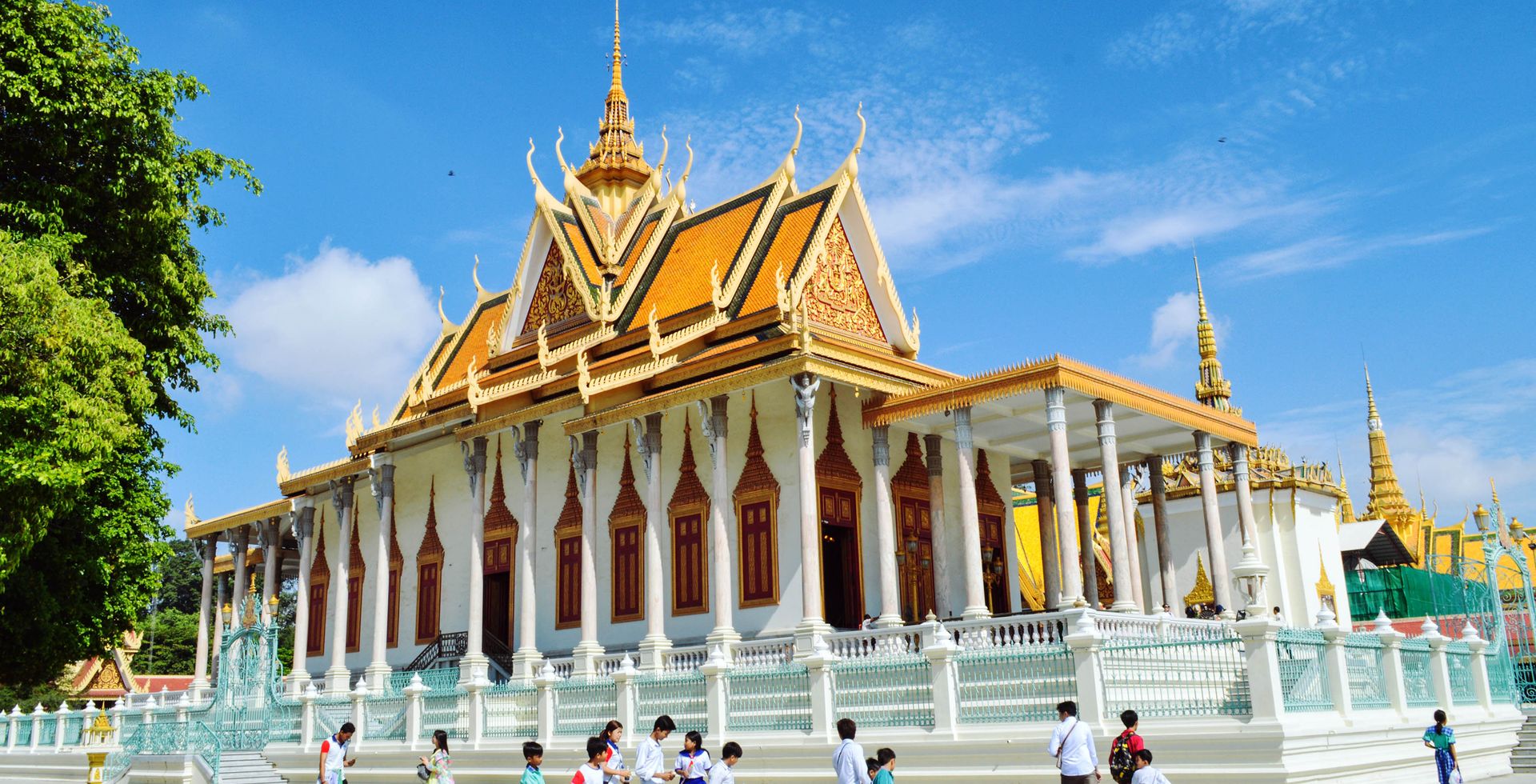
Phnom Penh
A capital reborn — where golden spires rise above a resilient past
Capital
Phnom Penh (national capital)
Currency
US Dollar (primary) & Cambodian Riel (KHR)
Climate
Tropical monsoon — hot year-round, wet May–October
Best Season
November–February (cool, dry, pleasant evenings)
Languages
Khmer, English, French (heritage)
Time Zone
ICT (UTC+7)
Driving Side
Right
Everything You Need to Know
Phnom Penh is a city that has stared into the abyss and chosen to dance. The Royal Palace and Silver Pagoda — with its floor of 5,329 solid silver tiles — gleam beside the confluence of the Mekong and Tonlé Sap rivers, a site so sacred that the city's mythical founding involves a woman named Penh who discovered four Buddha statues washed downstream. The National Museum, a terracotta masterpiece of Khmer architecture, houses the world's finest collection of Angkorian sculpture.
The city's darkest chapter is preserved with brutal honesty at Tuol Sleng Genocide Museum (Security Prison S-21), where the Khmer Rouge tortured and killed an estimated 20,000 people between 1975 and 1979. The Killing Fields of Choeung Ek, 15 kilometers south, contain mass graves and a memorial stupa filled with skulls — a visit that is devastating, essential, and ultimately a testament to the Cambodian spirit of survival.
Modern Phnom Penh pulses with new energy. The riverside promenade (Sisowath Quay) fills each evening with joggers, street food vendors, and families. The Bassac Lane bar strip hums with craft cocktails and live jazz. Street 240 and the Russian Market overflow with silk scarves, pepper from Kampot, and painted Khmer puppets. The food scene blends Khmer tradition — fish amok, nom banh chok, prahok ktiss — with French-inflected patisseries and a growing specialty coffee culture. Phnom Penh asks you to witness pain and beauty in the same breath, and it does not apologize for either.
Your Phnom Penh Journey
A day-by-day breakdown of your adventure — follow the road to discover what awaits at every stop.

 Day 1
Day 1Royal Palace & National Museum
Begin at the Royal Palace, where the Throne Hall's soaring Khmer roof and the Silver Pagoda's 5,329 silver floor tiles embody Cambodia's regal heritage. Cross to the National Museum — a red-sandstone courtyard masterpiece — to see Angkorian-era bronzes, stone lintels, and the iconic reclining Vishnu recovered from the Western Mebon temple.
- Walk the Silver Pagoda's floor of 5,329 solid silver tiles
- Admire the Throne Hall's golden Khmer spire
- View the reclining Vishnu bronze at the National Museum
- Stroll the museum's peaceful lotus courtyard at golden hour
Day 1Royal Palace & National Museum
Begin at the Royal Palace, where the Throne Hall's soaring Khmer roof and the Silver Pagoda's 5,329 silver floor tiles embody Cambodia's regal heritage. Cross to the National Museum — a red-sandstone courtyard masterpiece — to see Angkorian-era bronzes, stone lintels, and the iconic reclining Vishnu recovered from the Western Mebon temple.
- Walk the Silver Pagoda's floor of 5,329 solid silver tiles
- Admire the Throne Hall's golden Khmer spire
- View the reclining Vishnu bronze at the National Museum
- Stroll the museum's peaceful lotus courtyard at golden hour
 Day 2
Day 2Tuol Sleng & The Killing Fields
Visit Tuol Sleng Genocide Museum (S-21), a former high school converted into the Khmer Rouge's most notorious interrogation center. The audio guide — narrated by survivors — is essential. Continue to the Killing Fields of Choeung Ek, where a glass memorial stupa holds thousands of skulls excavated from mass graves.
- Listen to survivor testimonies on the Tuol Sleng audio guide
- Stand before the memorial stupa of skulls at Choeung Ek
- Read the personal histories of victims and survivors
- Reflect at the Killing Fields' mass grave pits and memorial tree
Day 2Tuol Sleng & The Killing Fields
Visit Tuol Sleng Genocide Museum (S-21), a former high school converted into the Khmer Rouge's most notorious interrogation center. The audio guide — narrated by survivors — is essential. Continue to the Killing Fields of Choeung Ek, where a glass memorial stupa holds thousands of skulls excavated from mass graves.
- Listen to survivor testimonies on the Tuol Sleng audio guide
- Stand before the memorial stupa of skulls at Choeung Ek
- Read the personal histories of victims and survivors
- Reflect at the Killing Fields' mass grave pits and memorial tree
 Day 3
Day 3Markets, Street Food & Sunset Cruise
Spend the morning at the Russian Market (Psar Toul Tom Poung) — a labyrinth of silk, silverwork, and kampot pepper. Sample num pang (Cambodian baguettes) and iced coffee at stalls outside, then take a sunset boat cruise on the Mekong at the Tonlé Sap confluence, watching the Royal Palace glow gold as evening falls.
- Bargain for silk scarves and Kampot pepper at the Russian Market
- Eat num pang (Cambodian baguette sandwiches) from a street cart
- Cruise the Mekong-Tonlé Sap confluence at sunset
- Watch the Royal Palace and riverside light up from the water
Day 3Markets, Street Food & Sunset Cruise
Spend the morning at the Russian Market (Psar Toul Tom Poung) — a labyrinth of silk, silverwork, and kampot pepper. Sample num pang (Cambodian baguettes) and iced coffee at stalls outside, then take a sunset boat cruise on the Mekong at the Tonlé Sap confluence, watching the Royal Palace glow gold as evening falls.
- Bargain for silk scarves and Kampot pepper at the Russian Market
- Eat num pang (Cambodian baguette sandwiches) from a street cart
- Cruise the Mekong-Tonlé Sap confluence at sunset
- Watch the Royal Palace and riverside light up from the water
 Day 4
Day 4Bassac Lane, Wat Phnom & Departure
Climb the small hill of Wat Phnom — the temple that gave the city its name — where legend says Lady Penh enshrined four Buddha statues found floating in the Mekong. Explore the city's French colonial architecture along Norodom Boulevard, then spend the final evening on Bassac Lane, sampling craft cocktails and live music at Phnom Penh's trendiest bar strip.
- Climb Wat Phnom, the city's founding temple on a wooded hill
- Walk Norodom Boulevard's French colonial facades
- Sip craft cocktails at Bassac Lane's intimate bars
- Try lok lak (pepper beef) at a traditional Khmer restaurant
Day 4Bassac Lane, Wat Phnom & Departure
Climb the small hill of Wat Phnom — the temple that gave the city its name — where legend says Lady Penh enshrined four Buddha statues found floating in the Mekong. Explore the city's French colonial architecture along Norodom Boulevard, then spend the final evening on Bassac Lane, sampling craft cocktails and live music at Phnom Penh's trendiest bar strip.
- Climb Wat Phnom, the city's founding temple on a wooded hill
- Walk Norodom Boulevard's French colonial facades
- Sip craft cocktails at Bassac Lane's intimate bars
- Try lok lak (pepper beef) at a traditional Khmer restaurant
Top Things to Do in Phnom Penh
Genocide History & Remembrance
Visit Tuol Sleng (S-21) and the Killing Fields to understand Cambodia's Khmer Rouge era — devastating but essential for any visitor.
Royal Palace & Silver Pagoda
Tour Cambodia's royal residence and its Silver Pagoda, whose floor of 5,329 silver tiles and Emerald Buddha are national treasures.
Riverside Sunset Cruises
Cruise the confluence of the Mekong and Tonlé Sap rivers at golden hour, watching the Royal Palace glow against the darkening sky.
Market Adventures
Navigate the Russian Market for silk and spices, the Central Market's Art Deco dome for gold jewelry, and street food stalls for num pang.
Khmer Cuisine Trail
Taste fish amok, prahok ktiss, kuy teav noodle soup, and fried tarantulas — Phnom Penh's food scene is adventurous and deeply flavorful.
Bassac Lane Nightlife
Phnom Penh's coolest bar strip serves craft cocktails, natural wines, and live jazz in a laneway of converted shophouses.
Essential Tips for Phnom Penh
Know before you go — practical advice to make your trip smooth and memorable.
Allocate a full morning for Tuol Sleng and the Killing Fields — rushing diminishes the experience. Bring tissues and water.
Tuk-tuks are the standard transport; agree on a price before departure ($2–4 for most trips within central Phnom Penh).
The Royal Palace requires covered shoulders and knees — sarongs are available to rent at the entrance for those who forget.
US dollars are used everywhere, but carry riel for change under $1; ATMs dispense both currencies.
Avoid tap water and ice from street stalls; reputable restaurants and cafés use purified ice (cylindrical with a hole).
The Sisowath Quay riverside area is pleasant for evening walks but be aware of bag-snatching — keep valuables secure.
Phnom Penh's traffic is intense — never assume vehicles will stop at crossings; look, walk slowly, and make eye contact with drivers.
Ready to Explore Phnom Penh?
Share your ideal trip details and our team will customize the perfect itinerary for you.
Call us
+91 98765 43210
Tour Duration
3 Nights / 4 Days